
Here's everything you need to know to grasp AI.
A Complete Overview of Artificial Intelligence
23 March, 2026
Everybody tells you to adopt AI, but nobody actually tells you HOW it works. More than acquiring technology, maximizing AI is about understanding the mechanics behind it. This introduction moves beyond the buzzwords to explain how different AI methods work, helping you align the right technical approach with the specific problem you are trying to solve.
What is AI?
Artificial Intelligence is a learning machine that takes vast input data to generate a specific output. Given its primary strength in learning, AI embeds all learned attributes from each use to guide its next processing, increasingly developing more concise, precise, and accurate output for every processed prompt.
AI researchers, developers, and firms design models through different architectures like neural networks, random forests, decision trees, and other function approximators. These architected models are then fed large datasets to sift through and generate output, creating an ever-improving network of learned commands and actions.
Classification by Capability
AI is not one technology or solution. It isn't magic. Under the broad umbrella of AI, different models fulfill different uses through specializing in different capabilities.
Rule-Based Systems: Rule-based systems use traditional expert systems that trigger deterministic, well-defined tasks through if/then rules.
Robotic Process Automation (RPA): RPA uses software bots to automate repetitive tasks like data entry and invoice processing.
Machine Learning: AI models learn from data and improve performance based on exposure to patterns.
Deep Learning: Uses neural networks for tasks like image recognition, speech, and NLP.
Knowledge Graphs: Structures relationships between data entities across systems.
Foundational Models: Generative AI models that can perform multiple tasks with minimal fine-tuning.
Retrieval Augmented Generation: Combines search with AI generation for more accurate results.
Classification by Operational Use
AI can be categorized into Generative AI and Agentic/Autonomous AI.
Agentic AI - Automation: Handles repetitive workflows.
Agentic AI - Decision Support: Provides insights and recommendations.
Generative AI - Prediction: Used for forecasting and anomaly detection.
Generative AI - Generation: Creates content like reports, emails, and code.
Which AI tools should I get according to my industry?
Financial Institutions: Credit scoring, fraud detection
Insurance: Claims automation, risk modeling
Retail: Recommendation engines, supply chain optimization
Healthcare: Medical imaging and diagnostics
Manufacturing: Predictive maintenance, robotics
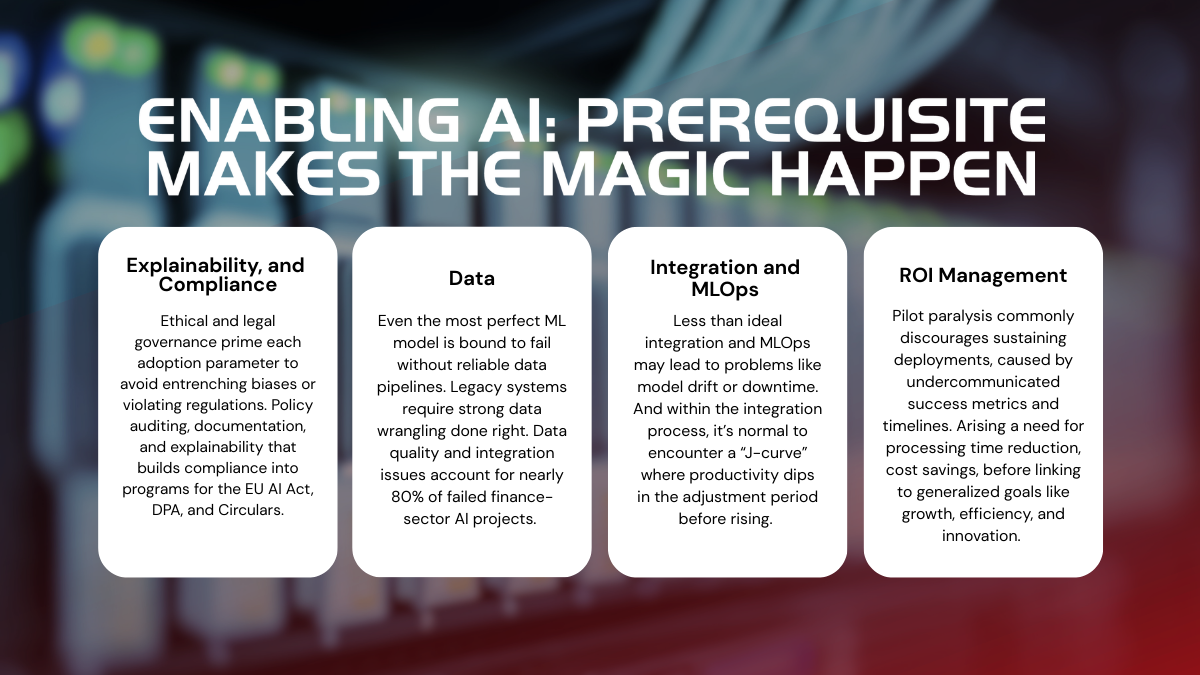
Enabling AI: Prerequisite makes the magic happen
AI isn't an isolated project that grows on its own. It requires work beyond the model. Prior to a full adoption, there are data, integration, and governance factors that we first need to keep in check.
Stop chasing 'AI' and start building your AI.
AI is not a single, universal solution; it is a diverse toolkit where the wrong application leads to wasted resources.
The most successful integrations follow a disciplined framework-- problem-first, not technology-first.
The right architecture will always trump the most popular one.
Lightstream8 provides targeted AI services and consulting to help you select and deploy the right tools for your specific industry needs.
Ready to build a purpose-driven AI roadmap? Contact Lightstream8 today.